
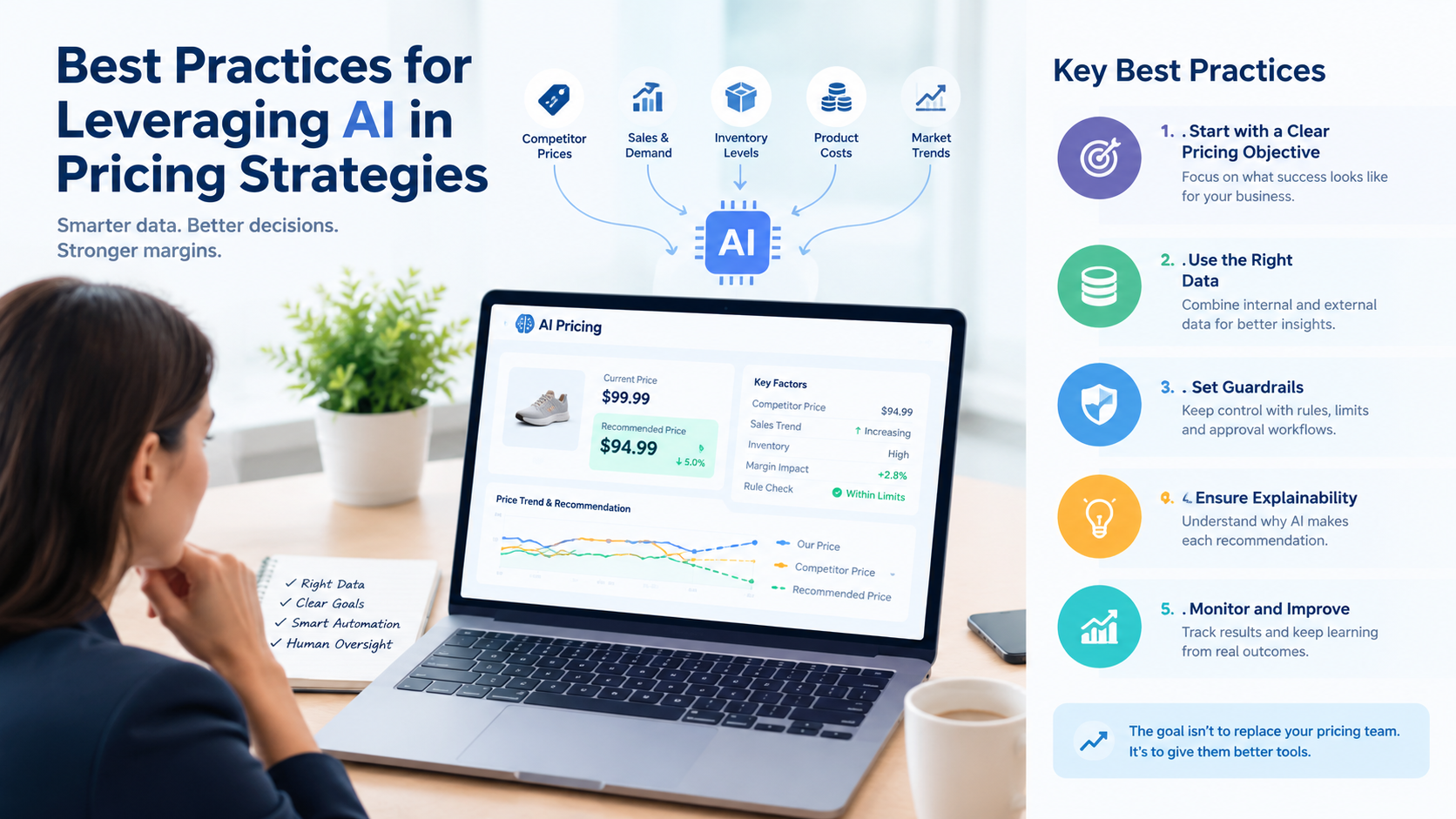
AI is becoming a practical tool for businesses that want to make better pricing decisions, not simply automate them. The real opportunity is to use AI to process market signals, identify pricing patterns, and recommend actions while keeping business rules and human judgment in the loop.
For retailers, this means moving beyond spreadsheets and manual competitor checks toward a more responsive pricing process.
Why Leveraging AI in Pricing Matters
For pricing teams, the value is not simply having more data. It is turning that data into useful recommendations.
Instead of asking, “What is our competitor charging?”, businesses can begin asking:
- Is our current price competitive?
- Are we leaving margin on the table?
- Should we react to a competitor’s price change?
- Which products require immediate attention?
- When should a promotion or markdown be adjusted?
1. Start With a Clear Pricing Objective
AI works best when it has a specific business goal.
Rather than asking an AI system to “optimize prices,” define what optimization means for your business. The objective could be:
- Improving gross margin
- Increasing conversion
- Protecting market share
- Reducing excessive discounting
- Improving inventory turnover
A clear objective also makes it easier to evaluate whether AI recommendations are actually creating business value.
2. Give AI the Right Pricing Data
The quality of an AI pricing recommendation depends heavily on the quality of its inputs.
A useful pricing system may combine:
- Product cost and target margin
- Historical sales
- Inventory levels
- Competitor prices
- Promotions and discounts
- Product demand
- Market conditions
For retailers, competitor monitoring is particularly useful because market prices can change faster than internal pricing teams can manually track.
3. Use AI for Recommendations
One of the most important practices is avoiding the idea that AI should control every price automatically.
A better approach is to let AI identify opportunities and recommend price changes while the business defines acceptable boundaries.
For example, a retailer can establish:
- Minimum margin thresholds
- Maximum discount levels
- Price floors
- Rules for promotional products
- Approval requirements for large price changes
This creates a practical balance between automation and control.
4. Make AI Pricing Explainable
A pricing recommendation is much easier to trust when users understand why it was generated.
Instead of simply showing:
Recommended price: $89.99
An effective system should explain the key factors behind the recommendation, such as:
Competitor price: $94.99
Current price: $99.99
Inventory: High
Recommended action: Reduce price to $94.99
This approach allows pricing managers to validate recommendations rather than treating AI as a black box.
5. Monitor Recommendations and Learn From Results
AI pricing should be treated as an ongoing process.
After a price change, businesses should monitor the result:
- Did sales increase?
- Did margin improve?
- Did conversion change?
- Did inventory move faster?
- Did competitors respond?
The results can then inform future pricing decisions.
This is particularly relevant as AI-based recommendation systems become more common. Statistics Canada reported that 17.9% of Canadian businesses using AI in Q2 2026 used AI-powered recommendation systems, up from 14.0% in Q2 2025.
AI Pricing Needs Governance
AI can make pricing more responsive, but it also introduces new considerations.
The Competition Bureau of Canada has specifically examined algorithmic pricing and noted that algorithms can help businesses respond to market conditions and improve efficiency, while also creating potential competition and consumer-protection concerns depending on how they are designed and used.
For this reason, retailers should combine AI with clear pricing policies, monitoring, and human oversight.
Final Takeaway
Leveraging AI in pricing is not about handing pricing decisions completely to a machine.
The stronger approach is to combine AI-powered analysis, reliable data, business rules, and human judgment.
For retailers, the goal is simple: identify pricing opportunities faster, understand the reasons behind recommended changes, and make better decisions with greater consistency.
AI should not replace pricing strategy. It should make pricing strategy more intelligent.