
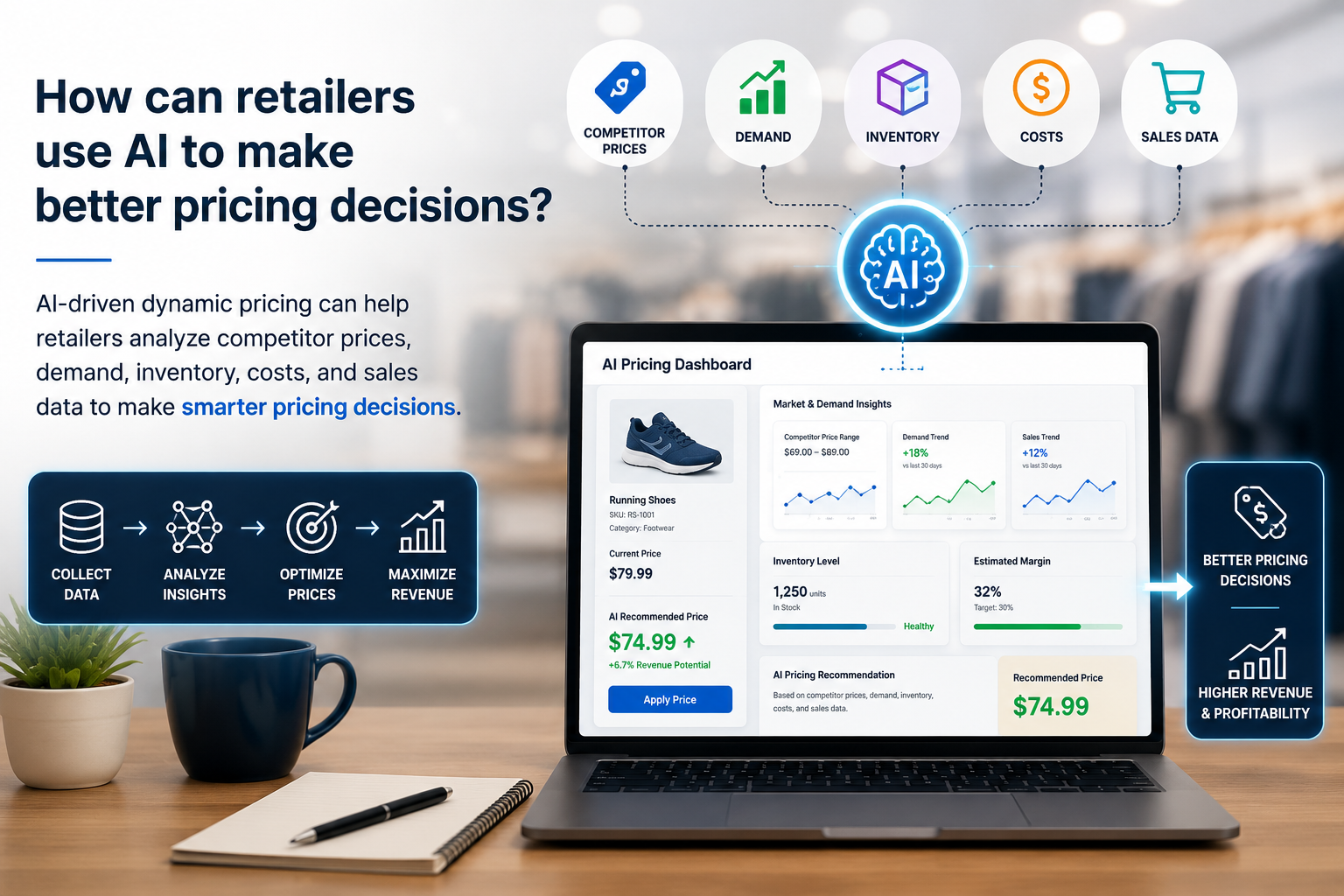
AI-driven dynamic pricing helps retailers make better pricing decisions by combining sales data, competitor prices, customer demand, inventory, and market conditions.
Instead of reviewing prices manually and reacting after the market changes, retailers can use AI to continuously analyze pricing signals and recommend when and how prices should change.
What Is AI-Driven Dynamic Pricing?
Dynamic pricing means adjusting product prices according to changing market conditions.
AI makes this process more intelligent. An AI-driven pricing system can analyze factors such as:
- Competitor prices
- Sales history
- Product demand
- Inventory levels
- Cost and margin
- Seasonal trends
- Market conditions
The goal is not simply to increase or decrease prices. The goal is to find a price that balances competitiveness, demand, revenue, and profit margin.
AI adoption is also becoming more common among Canadian businesses. Statistics Canada reported that 12.2% of Canadian businesses used AI to produce goods or deliver services in the 12 months preceding Q2 2025, up from 6.1% a year earlier.
Step 1: Collect the Right Pricing Data
An AI pricing model is only as useful as the data behind it.
Start by connecting the data your business already generates, including:
- Product and pricing data
- Sales transactions
- Competitor prices
- Inventory
- Product costs
- Discounts and promotions
For retailers, competitor pricing is particularly valuable. Knowing whether your price is above, below, or close to the market can help identify products that require attention.
Step 2: Define Your Pricing Rules
AI should not operate without business objectives.
Before building the model, define rules such as:
- Minimum acceptable margin
- Target price range
- Competitor price positioning
- Maximum discount
- Inventory-based pricing rules
For example, a retailer may want to remain competitive on high-visibility products while protecting margins on products with less direct competition.
This creates a practical balance between AI recommendations and business strategy.
Step 3: Build the AI Pricing Model
The model can use historical and real-time data to identify pricing patterns and estimate how customers may respond to different prices.
Different approaches can be used depending on the business, including regression models, machine learning algorithms, demand forecasting, and optimization models.
The important point is not choosing the most complicated algorithm. It is choosing a model that produces useful, explainable pricing recommendations.
Step 4: Test Before Automating
Do not immediately let AI change every price.
Start with recommendations and compare them with your existing pricing process. Test different pricing scenarios and measure their impact on:
- Revenue
- Gross margin
- Conversion rate
- Sales volume
- Inventory movement
A controlled test gives your team evidence that the model is improving decisions before you introduce automated repricing.
Step 5: Monitor and Improve
Markets change constantly. Competitors change prices, costs move, demand shifts, and customer behaviour evolves.
Your AI pricing system should therefore continuously monitor results and learn from new data.
A good pricing workflow looks like this:
Collect data → Analyze market conditions → Recommend price → Test → Measure results → Improve
AI does not replace pricing strategy. It makes the strategy faster, more data-driven, and easier to execute at scale.
Final Thoughts
Implementing AI-driven dynamic pricing does not have to start with a complex enterprise system.
Retailers can begin with a focused group of products, connect reliable pricing and competitor data, establish clear margin rules, and test AI recommendations before expanding.
The objective is simple: make better pricing decisions, faster, while protecting both competitiveness and profitability.
As AI becomes more widely adopted by Canadian businesses, data-driven pricing can become an important competitive advantage for retailers that are ready to move beyond manual price management. Statistics Canada’s latest business AI data provides evidence that this broader shift is already underway in Canada.
Source: Statistics Canada, Analysis on expected use of artificial intelligence by businesses in Canada, third quarter of 2025. Statistics Canada source