
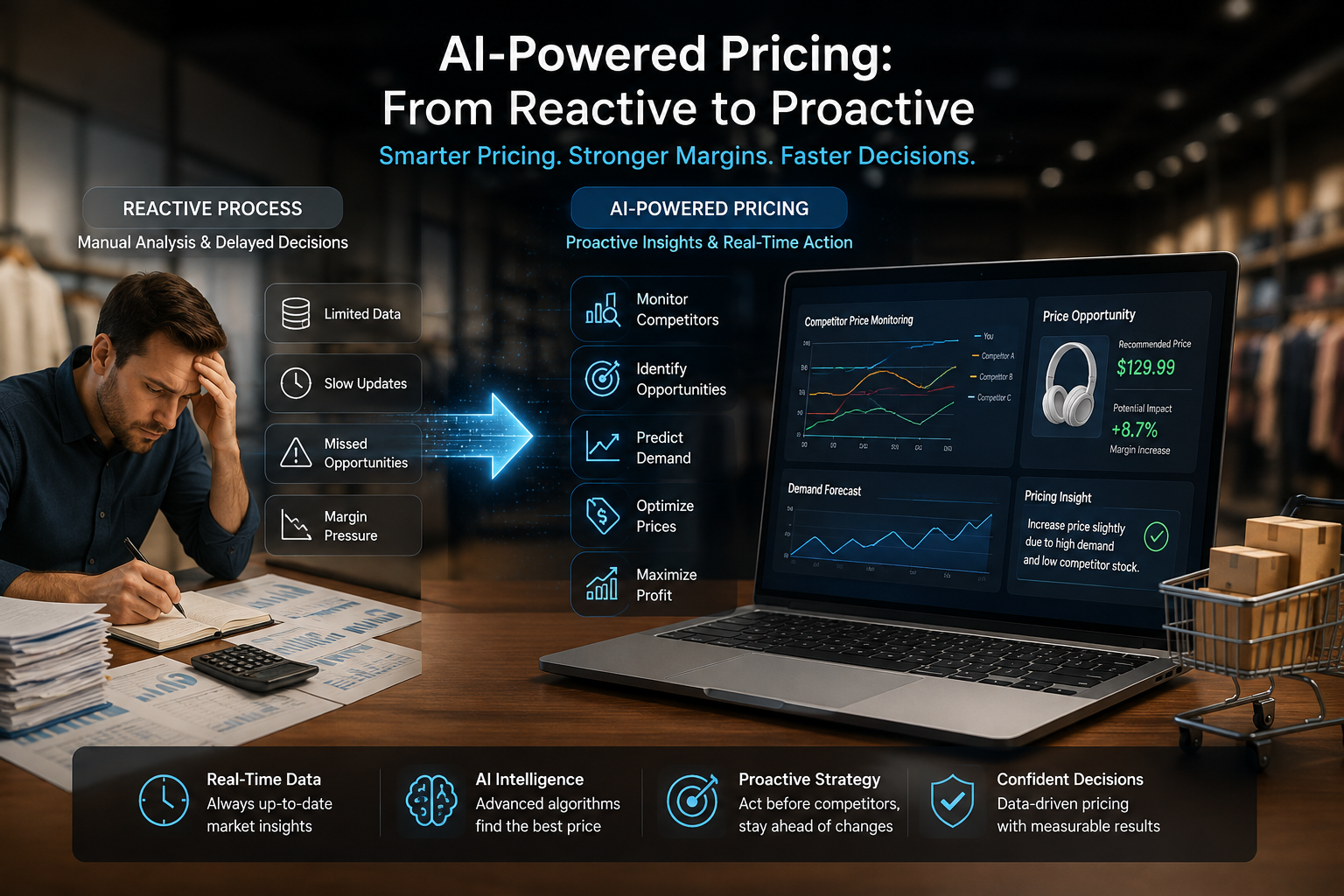
Pricing has never been more challenging. Customers compare prices across multiple stores in seconds, competitors update promotions constantly, and market conditions can shift overnight. For retailers, relying on manual pricing decisions is no longer enough.
Artificial intelligence (AI) is helping retailers make faster, smarter pricing decisions by analyzing data in real time. Instead of reacting after sales decline, businesses can adjust prices proactively to stay competitive while protecting profit margins.
According to Statistics Canada, 19.2% of Canadian businesses reported using AI in their operations in 2026, a significant increase from 12.2% in 2025, showing that AI adoption is accelerating across industries. (Statistics Canada)
Why Traditional Pricing No Longer Works
Many retailers still update prices manually or rely on spreadsheets and historical sales reports. While this approach may work for small inventories, it becomes difficult when managing hundreds or thousands of products.
Traditional pricing often struggles to keep up with:
- Frequent competitor price changes
- Seasonal demand fluctuations
- Inventory shortages or overstock
- Changes in customer buying behaviour
Without timely insights, retailers risk pricing products too high and losing sales, or too low and reducing profitability.
How AI Improves Pricing Decisions
AI-powered pricing platforms continuously analyze multiple data sources to recommend the best price for each product.
These systems can evaluate:
- Competitor pricing
- Historical sales performance
- Inventory levels
- Customer demand
- Profit margin targets
- Promotional performance
Instead of replacing pricing managers, AI provides recommendations that help teams make better-informed decisions more quickly.
Dynamic Pricing Without the Guesswork
Dynamic pricing allows retailers to update prices based on changing market conditions rather than fixed schedules.
For example, if demand increases while inventory becomes limited, AI may recommend a modest price increase to protect margins. If competitors lower their prices, AI can identify products where matching the market makes strategic sense while preserving profitability elsewhere.
The goal is not constant price changes—it is making pricing decisions based on data instead of assumptions.
Better Competitive Intelligence
Monitoring competitors manually is time-consuming, especially for retailers with large product catalogues.
AI pricing solutions can automatically track competitor pricing, detect significant market changes, and alert teams when action may be needed.
This helps retailers:
- Respond faster to competitor promotions
- Identify pricing gaps
- Protect market share
- Reduce manual monitoring
Instead of spending hours collecting pricing information, teams can focus on strategy and customer experience.
Smarter Inventory Management
Pricing and inventory are closely connected.
AI can identify slow-moving products and recommend promotional pricing before excess inventory becomes a problem. Likewise, products experiencing strong demand can maintain healthier margins without unnecessary discounts.
This creates a better balance between sales volume and profitability while reducing inventory carrying costs.
Things Retailers Should Consider
AI delivers the best results when supported by reliable data.
Before implementing an AI pricing solution, retailers should ensure they have:
- Accurate product and inventory data
- Consistent sales history
- Reliable competitor monitoring
- Clear pricing objectives
- Human oversight for strategic decisions
Retailers should also remain transparent with customers and ensure pricing practices comply with applicable privacy and consumer protection requirements.
Final Thoughts
AI is changing pricing from a reactive process into a proactive business strategy.
Instead of relying on manual analysis, retailers can use AI to monitor competitors, identify pricing opportunities, and respond to market changes with greater confidence.
For businesses managing growing product catalogues and increasingly competitive markets, AI-powered pricing is becoming less of a competitive advantage and more of a practical necessity.